Focused multimodal AI for earlier colorectal cancer signals

Understand your gut before things get worse.

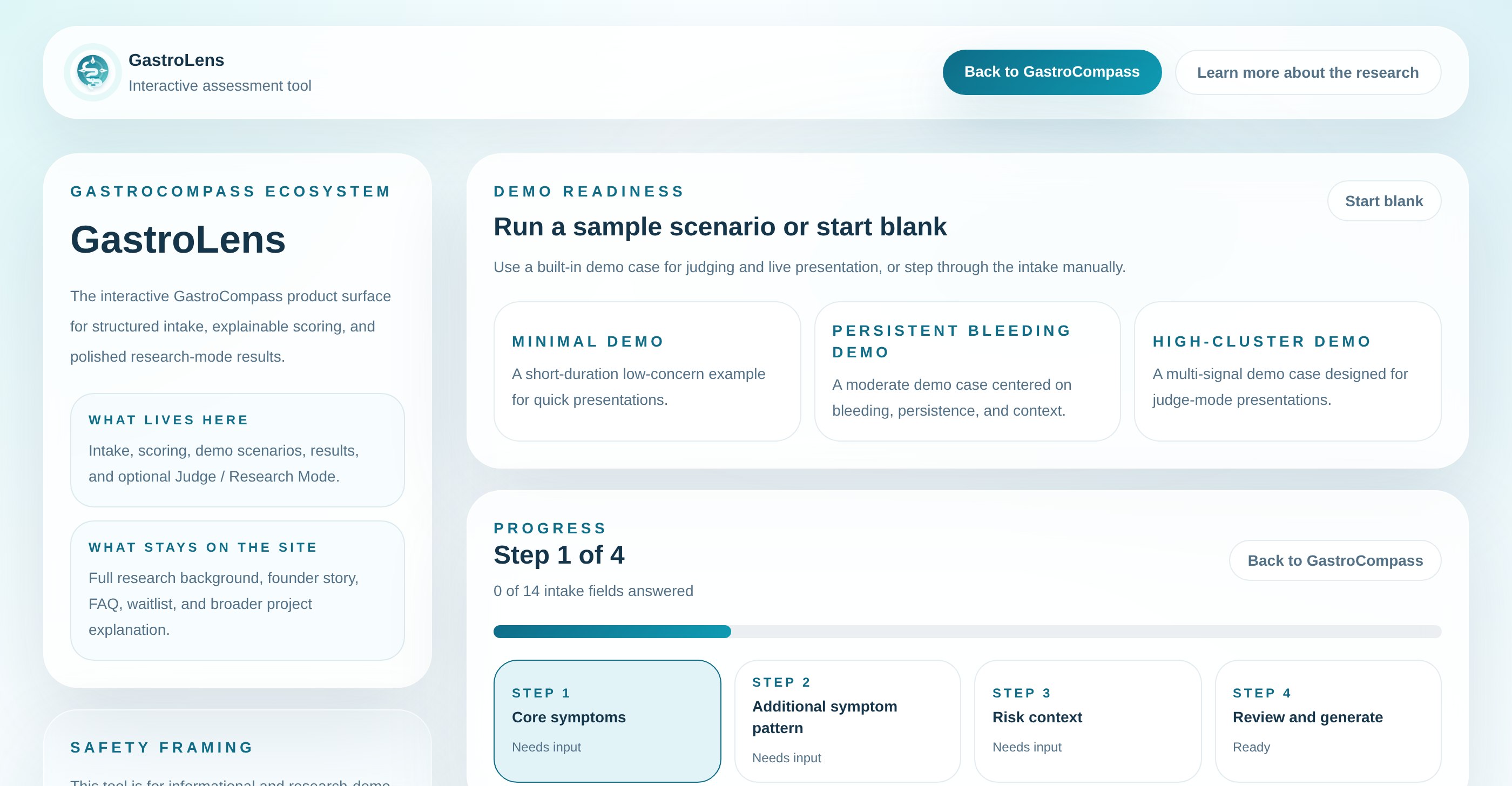
GI Compass is a pure AI platform for both patients and professionals. Patients upload symptom data, professionals upload colonoscopy and endoscopy images, and the AI combines both streams to surface earlier warning signs that may warrant follow-up for early-onset colorectal cancer.

  • Patient view for symptom upload and timeline tracking
  • Professional view for colonoscopy and endoscopy image upload
  • AI analysis that combines symptoms, image review, and clinician-ready summaries
The problem

Digestive symptoms are easy to ignore. That is the problem.

Early-onset colorectal cancer can be missed because initial symptoms may look vague, intermittent, or easy to explain away. Changes in bowel habits, rectal bleeding, abdominal pain, fatigue, and other symptoms do not always trigger the right level of concern early enough. GI Compass helps users track what they are feeling in one place so persistent symptom patterns are easier to catch and escalate sooner.

The solution

A sharper way to monitor signals that could point to early-onset colorectal cancer

Symptom Tracking

Patients can upload bowel changes, bleeding, pain, fatigue, appetite changes, and more in seconds.

AI Image Analysis

Professionals can upload colonoscopy and endoscopy images for AI-assisted review alongside symptom context.

Dual-View Summaries

Turn patient uploads and professional imaging findings into one organized summary both sides can follow.

Early Insight

Flag patterns that may suggest the need for earlier colorectal cancer workup or specialist follow-up.

Why the approach is different

Built as a multimodal AI system, not just a symptom diary

Patient AI intake

A structured symptom layer learns from recurring bowel patterns, bleeding, pain, fatigue, severity, and timing.

Professional imaging AI

A CNN-based layer analyzes colonoscopy and endoscopy image uploads and adds signal beyond self-report alone.

More useful early flags

The goal is to surface people who may need a closer look sooner by merging patient-entered symptoms and clinician-uploaded imaging.

How it works

How GI Compass works

1

Track

Patients upload symptom data while professionals upload colonoscopy or endoscopy images.

2

Analyze

The AI analyzes symptom persistence, cluster behavior, image features, and multimodal correlations.

3

Act

Patients and professionals receive one clear output with AI flags, organized evidence, and next-step support.

Focused clinical direction

Starting with early-onset colorectal cancer

GI Compass is being shaped around a narrower, clinically meaningful question: can multimodal AI help flag people who may need earlier evaluation for early-onset colorectal cancer? That focus is stronger because it targets an urgent problem with clear real-world value, instead of trying to cover a broad and noisy GI category. The product is intended to work across both patient and professional workflows.

The goal is earlier recognition and better escalation, not diagnosis inside the app.

Example use case

Persistent bowel changes and bleeding should not stay buried in vague symptom history.

Why it matters

A better early flag could help move the right patients toward evaluation sooner and create clearer clinical value than a broad GI screener.

Why this matters

Why this matters

Early symptoms are often the first signal that something is wrong, but they are easy to miss when they happen across days or weeks. GI Compass helps turn scattered symptoms into a clearer picture and focuses on situations where earlier pattern recognition could change the care pathway. The goal is not to diagnose. The goal is to help people notice patterns earlier, feel more in control, and be better prepared when talking to a doctor.

GI Compass is designed as a support tool, not a replacement for professional medical care.

Pattern summary

Repeated bowel changes and bleeding are persisting instead of resolving.

Clarity for appointments

Bring organized symptom history instead of trying to recall isolated episodes from memory.

Feature spotlight

Built for real life

Fast daily check-ins

Designed for busy routines, not long forms.

Clean symptom graphs

See change over time without digging through notes.

Trigger and flare tracking

Connect symptoms to food, sleep, stress, and timing.

Exportable summaries

Share concise reports with a doctor or caregiver.

Private and secure design

Built with health data sensitivity, privacy, and trust in mind.

Easy for teens and families to use

Simple enough for daily use across ages while still being research-minded.

The vision

Why GI Compass was created

GI Compass was built around a simple idea: people often feel symptoms long before they get answers. Digestive health can be confusing, frustrating, and hard to explain. This project is being shaped around a specific, clinically meaningful question: how to detect stronger early signals for early-onset colorectal cancer and help patients get to the right next step sooner.

A mission-driven product direction for patients, families, and future clinical partners who need a clearer picture of digestive health over time.

Founder vision
Partnerships

Built with future clinical partnerships in mind

GI Compass is designed to support better symptom documentation, clearer patient communication, focused clinical use cases, and stronger research conversations as the product evolves.

Patient-centered Research-aware Clinician-friendly summaries
FAQ

Common questions

Is GI Compass a diagnosis tool?

No. GI Compass is meant to help users organize symptoms and notice patterns, not diagnose or replace medical care.

What symptoms can I track?

You can track pain, bloating, bowel habits, nausea, fatigue, meals, triggers, and other daily notes.

What makes GI Compass different from a regular symptom tracker?

GI Compass is being built as a multimodal AI platform that combines structured symptom data with imaging-informed analysis to create stronger early signals.

Who is this app for?

It is built for teens, adults, parents, and anyone trying to understand ongoing digestive symptoms more clearly.

Can I share my results with a doctor?

Yes. GI Compass is designed to make it easier to export concise summaries and bring them into appointments.

What condition is GI Compass focused on first?

The current product direction is focused on early-onset colorectal cancer, where earlier symptom pattern recognition could support faster evaluation and clearer clinical action.

Is my health data private?

The product vision prioritizes privacy, secure handling, and transparent use of health information.

Early access

Be first to try GI Compass

Join the early access list to get updates, previews, and launch news.

Contact

Get in touch

General contact

Email the team

Questions about the project, early access, research interest, or future clinical partnerships can be sent directly by email.

tanush.nimmalapudi@gastrocompass.org
Best for

What to reach out about

Early access Research Clinical partnerships School projects Product feedback

For now, the fastest way to connect is by email while the full waitlist and contact workflow is being built.