Symptom Tracking
GastroLens lets users log rectal bleeding, bowel changes, abdominal pain, fatigue, weight loss, and symptom duration in a short structured intake.
Gastro Compass is the umbrella project behind GastroLens. GastroLens is now live in its first version as the interactive research-mode tool built to help document persistent symptom patterns related to early-onset colorectal cancer concern. It remains non-diagnostic, safety-first, and not clinically validated, but it is now available to launch directly from the GastroCompass site as the connected product experience.
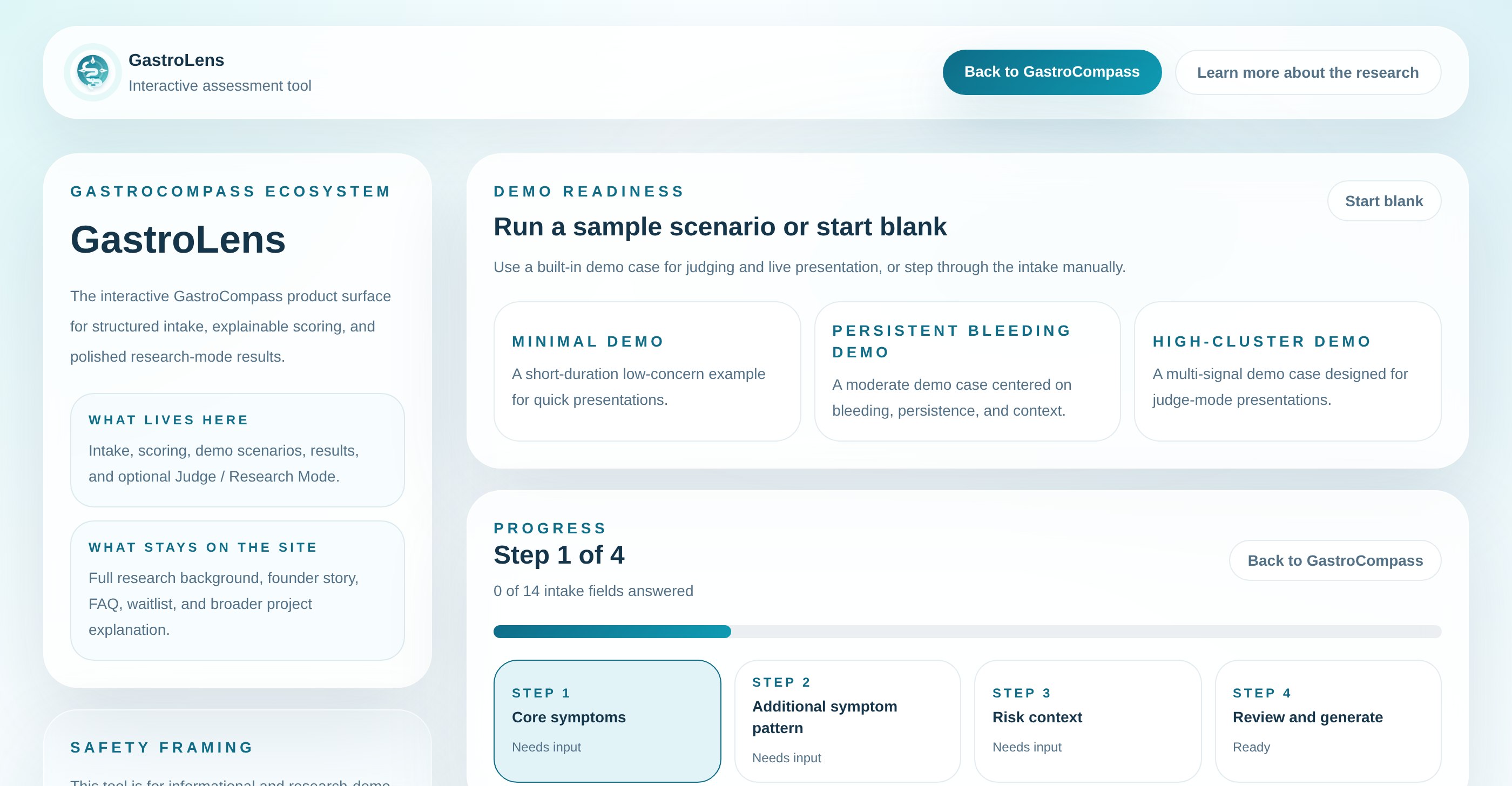
These presets mirror the live GastroLens demo and judging flow.
A step-based intake leads to an explainable research summary.
Safety language stays non-diagnostic and follow-up oriented.
Built as a short guided intake rather than a long medical questionnaire.
The structure is visual, quick to complete, and easy to explain in a demo.
The live app keeps the research framing while making the workflow directly launchable from the site.
Based on the real GastroLens results panel.
Scores are broken into explainable sections.
The result is framed as a reason to follow up, not a diagnosis.
Shows weighted rule interactions behind the score.
Flags contradictions and edge cases in the logic.
Designed for demos, judging, and review sessions.
This panel reflects the actual GastroLens app structure now available from the site.
GastroLens is the live first-version interactive tool from Gastro Compass. It is designed to help organize persistent symptom patterns, apply symptom-first risk flagging logic, and prepare clearer non-diagnostic follow-up summaries for under-50 colorectal cancer concern.
Use the main site for the research story and product context. Use GastroLens for the actual intake, scoring, and research-style results experience.
Early-onset colorectal cancer can be missed because initial symptoms may look vague, intermittent, or easy to explain away. Changes in bowel habits, rectal bleeding, abdominal pain, fatigue, and other symptoms do not always trigger the right level of concern early enough. Gastro Compass is focused on that failure mode, and GastroLens now turns that work into a clearer, symptom-first first-version workflow for earlier escalation support.
GastroLens lets users log rectal bleeding, bowel changes, abdominal pain, fatigue, weight loss, and symptom duration in a short structured intake.
Family history, age group, and prior evaluation status help frame the symptom pattern more realistically.
Turn messy symptom history into one organized research-style summary that patients and clinicians can review more clearly.
Highlight symptom patterns that may warrant earlier physician follow-up instead of continued dismissal or delay.
Early-onset colorectal cancer is one of the few GI problems where warning symptoms often exist but are written off as IBS, hemorrhoids, stress, or anxiety.
Gastro Compass brings together the completed paper, prototype design process, NHANES-grounded feasibility work, and three empirical analyses behind the concept.
The imaging layer remains future work until it can be trained and validated on clinically meaningful data. The symptom-side is the tractable first build.
GastroLens is positioned as an escalation support tool, not a diagnosis tool. The product stays non-clinical until it is properly validated.
GastroLens is the live first-version interactive tool built from the Gastro Compass research hub. This section shows the current workflow, why it matters, and how the app is intended to support follow-up inside a research-mode interactive tool.
Users log symptoms such as rectal bleeding, bowel changes, abdominal pain, fatigue, and weight loss in a structured first-pass intake.
The app turns symptom entries into a clearer organized view instead of leaving important details scattered across memory and notes.
The rule-based system weighs persistence, recurrence, and risk context like age group, family history, and prior evaluation status.
The output is a summary that says the pattern warrants a conversation with a physician, not a diagnosis inside the app.
Gastro Compass holds the research story together: the completed paper, prototype design work, NHANES-grounded feasibility analysis, and three empirical analyses that make the GastroLens concept more credible. The prototype comes after that foundation, not before it.
Evidence base
Current product status
GastroLens is now live in a first version: research-driven, safety-first, and clearly framed as a non-diagnostic tool.
Gastro Compass is the umbrella project shaping the research and product direction. GastroLens is now the interactive first-version tool in that ecosystem, while the site continues to carry the deeper research story, safety framing, and broader project context around it.
What Gastro Compass provides
Now live
GastroLens launch access, product updates, and continued research-mode improvements.
The live workflow uses quick structured logging rather than long medical forms.
The app centers on patterns that make ongoing changes easier to see and explain.
Age group, family history, and prior evaluation stay part of the current review logic.
The live tool is aimed at concise outputs users could bring into follow-up conversations.
The app stays intentionally non-diagnostic and clearly separate from clinical validation.
The interface is live as a serious first version, with room to mature rather than pretending to be fully finished.
Gastro Compass is already carrying the research story: the completed paper, the product design process, NHANES-grounded feasibility work, three empirical analyses, and a safety-first non-clinical framing. That is what gives GastroLens a stronger foundation as a live first-version tool rather than a rushed public app.
Gastro Compass is the umbrella project behind GastroLens. It brings together the research framing, product context, live app access, and ongoing updates in one place.
Yes. GastroLens is now live in a first version through the GastroCompass site as an interactive research-mode assessment tool.
GastroLens is a symptom-first GI risk flagging tool that helps organize persistent warning signs, risk context, and follow-up-ready summaries for under-50 colorectal cancer concern.
No. The Patient View, Professional View, AI Review, and Exports tabs still represent broader product directions beyond the current live first version.
No. GastroLens is framed as a non-diagnostic escalation support tool. It is not clinically validated and is not meant to replace professional medical care.
The research direction is focused on the documented failure mode where symptoms are present in under-50 patients but repeatedly dismissed, making symptom-first risk flagging more clinically meaningful than a broad GI classifier.
No. Imaging remains a roadmap feature and will only make sense once it can be trained and validated on clinically meaningful data. The symptom-side is the first build.
Join the waitlist to get updates about new features, research progress, product improvements, and future rollout milestones.
Get notified about product improvements, research milestones, and future rollout updates as GastroLens continues to evolve.
Questions about the project, early access, research interest, or future clinical partnerships can be sent directly by email.
tanush.nimmalapudi@gastrocompass.orgFor now, the fastest way to connect is by email while the full waitlist and contact workflow is being built.