A Gastro Compass project GastroLens app available

Meet GastroLens, the interactive research-mode prototype from GastroCompass.

Gastro Compass is the umbrella project building GastroLens. GastroLens is the upcoming research-mode prototype built to organize persistent symptom patterns, risk context, and follow-up-ready summaries for early-onset colorectal cancer concern. It is non-diagnostic, not clinically validated, and now connected to the main site as the interactive demo layer.

GastroLens App Preview Prototype UI
Actual app preview

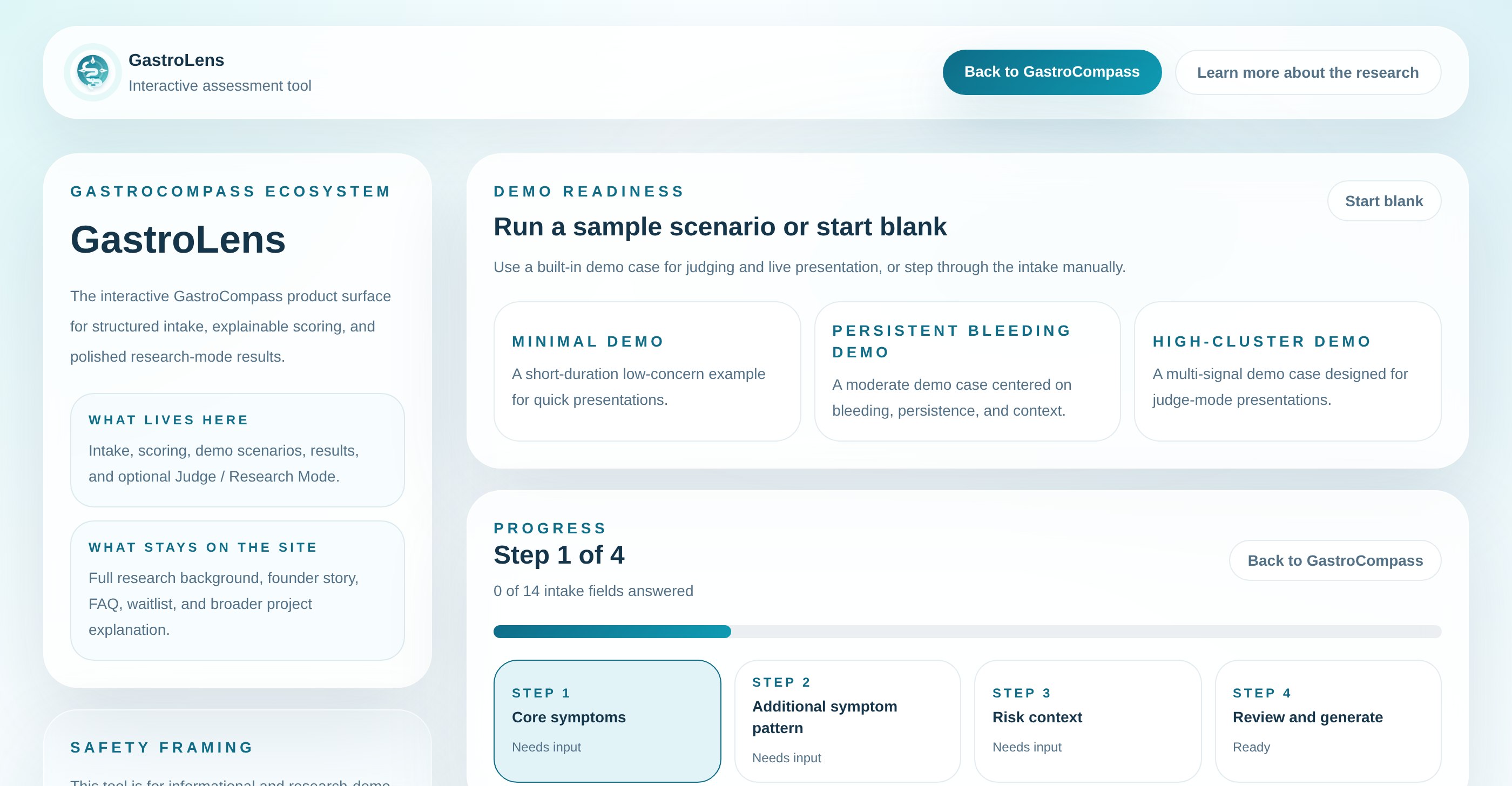
Start with a sample scenario

Minimal demo Persistent bleeding High-cluster demo

These presets mirror the real GastroLens demo and judging flow.

What lives here

What GastroLens is built around

Structured intake Explainable scoring Research-mode results

A step-based intake leads to an explainable research summary.

Safety framing

Research mode, not diagnosis

Informational only Non-diagnostic Clinician follow-up encouraged

Safety language stays non-diagnostic and follow-up oriented.

Step 1 of 4

Core symptoms

Rectal bleeding Persistent
Bowel change Significant
Duration 6+ weeks

Built as a short guided intake rather than a long medical questionnaire.

4-step flow

Move from symptoms to summary

1
Core symptoms Current step
2
Additional signals Next up
3
Risk context Family history and screening
4
Review and generate Prepare summary

The structure is visual, quick to complete, and easy to explain in a demo.

Navigation

Guided from start to result

Sample scenarios Guided prompts Generate summary

The preview mirrors the real GastroLens flow without pretending the product is public yet.

Research summary

Moderate flag

Total score 8
Pattern lens: persistent bleeding Driver summary: duration + bowel change Follow-up-oriented language

Based on the real GastroLens results panel.

Section contributions
Core symptoms 4 points
Additional pattern 2 points
Risk context 2 points

Scores are broken into explainable sections.

Safety-first output

Built for escalation support

Pattern explanation Safety note Care conversation

The result is framed as a reason to follow up, not a diagnosis.

Judge / Research Mode

What Judge Mode reveals

Interaction bonuses

Shows weighted rule interactions behind the score.

Validation notes

Flags contradictions and edge cases in the logic.

Share view

Presentation actions

Copy summary Print summary Start a new assessment

Designed for demos, judging, and review sessions.

Actual app direction

Deterministic, explainable, and demo-ready

Step-based intake Transparent scoring Judge mode extras

This preview now reflects the actual GastroLens app structure.

Prototype architecture

How the GastroLens concept is being structured

Patient View

Symptom and context intake

Rectal bleeding, bowel changes, abdominal pain, fatigue, duration, family history, age, ethnicity, and prior colonoscopy status.

GastroLens prototype

Symptom-first risk flagging

Structured analysis of persistence, recurrence, and documented risk context, with imaging review kept as a future validated layer.

Professional View

Action-ready review

Clinician-facing summaries designed to support earlier follow-up conversations, not replace clinical judgment.

Preview views

One symptom-first system, with imaging kept as roadmap work

Prototype view

Upload symptoms and follow patterns

The prototype direction centers on structured symptom data, trend timelines, and clearer summaries patients could bring into physician visits.

Roadmap view

Future imaging review

The imaging component remains future work until it can be trained and validated on a clinically meaningful dataset with clear performance thresholds.

GastroLens workflow preview

What the upcoming workflow is designed to do

01

Capture

Patients would upload symptoms through structured prompts along with risk context such as age, ethnicity, family history, and prior colonoscopy status.

  • Patient symptom timeline
  • Age and demographic intake
  • Family history and prior screening
  • Context and notes
02

Organize

The prototype converts daily logs into a structured timeline so patterns are visible instead of buried across isolated notes.

6-week persistence window
03

Analyze

The planned first model would look for symptom clusters, persistence, and risk stratification patterns that support earlier follow-up in the right patients.

Symptom classifier Risk context Duration weighting Escalation support
04

Escalate

The result is not a diagnosis. It is a clearer signal that says the pattern warrants a conversation with a physician.

Follow-up support

Future summaries are intended to highlight persistent patterns that should not be dismissed without review.

Shared output

Built to make the next decision clearer

GastroLens is being organized to turn scattered symptom history and risk context into one usable output: a planned AI-supported review that is easier to act on and easier to bring into care.

Patient output

Clearer symptom history

Patients get organized timelines and summaries they can understand and share.

Professional output

Escalation-ready summary

Professionals get organized symptom context, risk factors, and one clearer review pathway for follow-up conversations.

Research foundation

Why GastroLens is being built this way

GastroLens is coming out of a research-first process, not a rushed app launch. The work behind it includes the completed research paper, the prototype design process, NHANES-grounded feasibility work, and three empirical analyses used to test whether the concept is credible enough to build. That is why the prototype is being kept clearly non-diagnostic and clearly in development.

A preview-stage prototype grounded in evidence, shaped by design work, and held to a safety-first standard before public release.

Coming soon